
While these molecules share themes of tissue support and signaling (each has its own evidence base), and combining them should be approached with the same scientific skepticism applied to any single agent. It is also worth noting how GHK-Cu relates to the broader landscape of regenerative peptides studied for tissue repair, such as those reviewed in our guide to peptides for hair. Copper peptides can be incompatible with certain actives in the same product or applied at the same time, so spacing applications or choosing professionally formulated blends helps preserve stability and efficacy. One of GHK-Cu’s most appealing characteristics is that it occupies a different mechanistic niche from most hair-loss therapies — which makes it a natural candidate for combination approaches. This article is educational and does not constitute medical advice; legal and regulatory status of peptide products varies by jurisdiction. As a naturally occurring molecule present in the body (it is generally well tolerated at the low concentrations used in serums), and serious adverse events from topical application are uncommon in the literature.
GHK-Cu is proposed to act on collagen and vascular pathways in the dermis MOTS c rather than on the hormonal pathway that drives pattern loss. Rapid shedding (patches or scarring need a doctor), because some causes are treatable and time-sensitive. Sudden or patchy hair loss That is a diagnosis question, not a serum question.
The evidence base for GHK-Cu in female-pattern hair loss is smaller still than for male pattern. Combinations should be sequenced to avoid stacking irritation, and started one at a time so reactions can be attributed. The product should be massaged in lightly and left on; some formulations are washed off after a contact time, others leave on indefinitely.
Copper-free GHK, copper ions and a prepared GHK-Cu complex can answer different experimental questions, so the tested material should always be named. A material’s identity does not establish a particular human benefit. It is studied in laboratory models and in some topical formulations. Vehicle, viability and model-appropriate positive controls help separate the intended effect from unrelated changes. Human formulation studies are a separate branch of that history, with their own comparisons and limitations.
The Locations of Open Questions
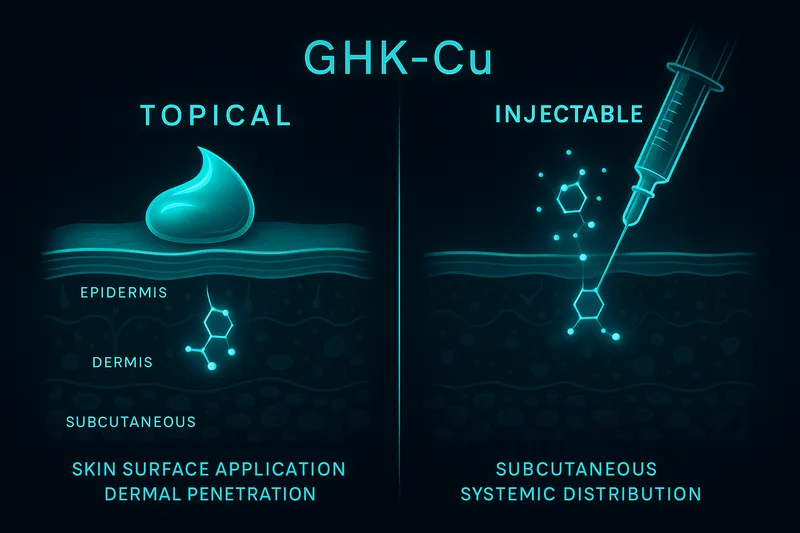
It has been shown to attract immune and repair cells to injury sites, promote the formation of new blood vessels (angiogenesis), stimulate collagen and matrix deposition, and support the remodeling phase of healing. It appears to modulate the expression of a broad set of genes, including some tied to tissue remodeling and antioxidant responses. This article walks through what GHK-Cu is (what the topical and cosmetic research actually shows), where the wound-healing story sits, and which claims are still preclinical rather than proven in people.
Combination approaches using microneedling with copper peptide serums have gained popularity in clinical settings, though controlled data specifically on copper peptide microneedling (without other active ingredients) remains sparse. The scalp tattooing method used in the 2025 JAAD International study represents a more aggressive delivery approach. The system was thermodynamically stable, meaning it maintained its structure over time without separating. The 2023 study by Liu et al. designed a bio-based microemulsion using carnitine and tartaric acid , CaT-ME, that improved local delivery of copper peptides by approximately three-fold. One of the biggest practical challenges with copper peptides for hair is getting them where they need to go. For context on other peptides being studied for hair restoration — see our guide to the best peptides for hair growth.
Reports skin benefits but little change in hair, and is adding a topical form to see if it helps. There was no control group — and copper tripeptide-1 was one of six ingredients, so the result cannot be credited to GHK-Cu . A rat study reported follicle enlargement with a copper-binding peptide (and an uncontrolled human study tested a six-ingredient scalp injection containing copper tripeptide-1), so it cannot establish the peptide’s effect . Anything beyond cosmetic topical use, including injection, has no established human safety profile.
Tissue concentrations achieved through injectable delivery are significantly greater than those obtained from topical application. Since peptides require time to exert their cumulative cellular effects, it may take 12 months or even longer to see full results. Within 4 to 8 weeks, a majority of users observe a decrease in shedding.
Does Clinical Evidence Support the Hair Regrowth Properties of GHK-Cu?
The FDA has not approved GHK-Cu as a drug for any of the biological effects mentioned in the research literature, which include applications for skin, wound repair, fibrosis, muscle, or bone. The findings depend on the model used, and the translation of results from culture systems to outcomes in whole organisms remains a question currently under investigation rather than one with established answers. Research published in this domain has focused on alterations in collagen and glycosaminoglycan production, the expression of matrix metalloproteinases along with their tissue inhibitors, and gene-expression profiling that reveals significant shifts in pathways related to matrix remodeling. In the article on copper delivery (further information regarding coordination chemistry can be found), accompanied by redox considerations detailed in the guide on antioxidant mechanisms. The control of free copper’s redox activity within tissue is critical; it is suggested that chelation within the tripeptide enables transport while avoiding unregulated Fenton-type reactions. The article comparing GHK-Cu to vitamin A derivatives addresses discussions on retinoid chemistry.

To broaden your understanding and continue your education with evidence-based content — explore related articles on peptides, research findings, and practical guides. Conducting patch tests on new products and introducing only one active ingredient at a time helps in early detection of any reactions. Errors in reconstitution and concentration are among the most common mistakes in peptide work, which is why we provide calculators and dosing explainers.